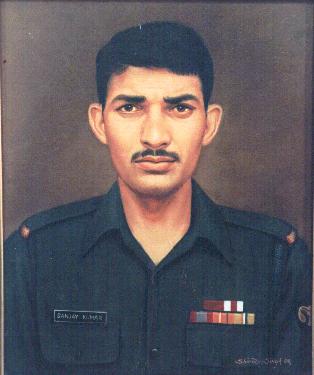
Rifleman Sanjay Kumar, 13 JAK Rifles, was the leading Scout of a team tasked to capturing Area Flat Top on 04 July 1999 being held by Pakistani-backed militants. Having scaled the cliff, the team was pinned down by machine gun fire from an enemy bunker, 150 meters away. Rifleman Kumar, realizing the magnitude of the problem and the detrimental effect this bunker would have in the capture of Area Flat Top, displayed extraordinary courage. Without concern for personal safety, he crawled alone up the ledge, along a flank, and charged towards the enemy bunker, through a hail of automatic fire. Almost instantly he took two bullets in his chest and forearm.
Bleeding profusely from the bullet wounds, he continued the charge towards the bunker. Unhesitant, he then picked up the enemy machine gun and crept towards the second enemy bunker. Three enemy soldiers, taken completely by surprise were killed by him on the spot. Inspired by his dare devil act the rest of the platoon, emotionally charged, assaulted the feature and captured Area Flat Top. For his sustained display of the most conspicuous personal bravery and gallantry of the highest order in the face of the enemy, Rifleman Sanjay Kumar was awarded the Param Vir Chakra, India 's highest medal for gallantry.
CITATION
RIFLEMAN SANJAY KUMAR
13 JAMMU AND KASHMIR RIFLES (13760533)
Rifleman Sanjay Kumar volunteered to be the leading scout of the attacking column tasked to capture area Flat Top of Point 4875 in the Mushkoh Valley on 4 July 1999. During the attack when enemy automatic fire from one of the sangars posed stiff opposition and stalled the column, Rifleman Sanjay Kumar realizing the gravity of the situation and with utter disregard to his personal safety, charged at the enemy. In the ensuing hand-to- hand combat, he killed three of the intruders and was himself seriously injured. Despite his injuries, he charged onto the second sangar. Taken totally by surprise, the enemy left behind a Universal Machine Gun and started running.
Rifleman Sanjay Kumar picked up the UMG and killed the fleeing enemy. Although bleeding profusely, he refused to be evacuated. The brave action on his part motivated his comrades and they took no notice of the treacherous terrain and charged onto the enemy and wrested the area Flat Top from the hands of the enemy.
Rifleman Sanjay Kumar displayed most conspicuous gallantry, cool courage and devotion to duty of an exceptionally high order in the face of the enemy.
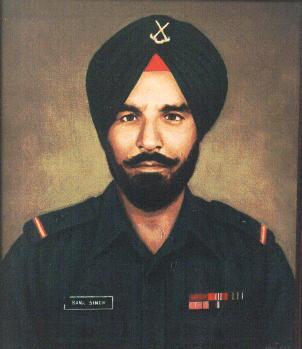
Naib Subedar Bana Singh, born in Kadyal, Jammu on 6 January 1949, was enrolled in the Indian Army on 6 January 1969 into the Jammu & Kashmir Light Infantry (JAK LI). During June 1987, the 8 JAK LI, was deployed in the Siachen area. It was then found that a large number of Pakistani infiltrators had intruded in the Siachen Glacier. The ejection of these infiltrators was considered difficult but necessary and a special task force was, constituted for the purpose. Naib Subedar Singh volunteered to join this force.
The Pakistani intrusion had taken place at a height of 6500 metres. The enemy post was virtually an impregnable glacier fortress with ice walls, 457 metres high, on either side. Naib Subedar Bana Singh led his men through an extremely difficult and hazardous route. He inspired them by his courage and leadership. He and his men crawled and closed in on the adversary. Lobbing hand-grenades, charging with a bayonet and moving from trench to trench, he cleared the post of all intruders. Naib Subedar Bana Singh was awarded the Param Vir Chakra, the highest wartime gallantry medal, for conspicuous bravery and leadership under most adverse conditions.
CITATION
NB SUB BANA SINGH
8 JAK LI (JC-155825)
Naib Subedar Bana Singh volunteered to be a member of a task force constituted in June 1987 to clear an intrusion by an adversary in the Siachen Glacier area at an altitude of 21,000 feet. The post was virtually an impregnable glacier fortress with ice walls, 1500 feet high, on both sides. Naib Subedar Bana Singh led his men through an extremely difficult and hazardous route. He inspired them by his indomitable courage and leadership. The brave Naib Subedar and his men crawled and closed in on the adversary. Moving from trench to trench, lobbing hand grenades, and charging with the bayonet, he cleared the post all intruders.
Nb Subedar Bana Singh displayed the most conspicuous gallantry and leadership under the most adverse conditions.
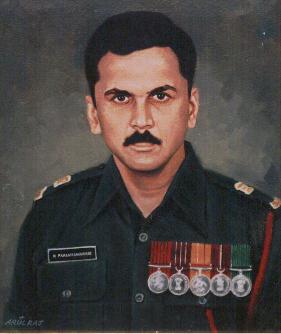
Major Ramaswamy Parameswaran, was born on 13 September 1946, in Bombay , Maharashtra . He was granted Short Service Commission in the Mahar Regiment on 16 January 1972. He took part in a number of operations undertaken by the Indian Army. Under the Indo-Sri Lanka Agreement many Indian Army units were dispatched to Sri Lanka to maintain law and order there. The Mahar Regiment, Major Parameswaran's unit, was also sent to Sri Lanka to participate in Operation Pawan. On 25 November 1987, Major Parameswaran was returning with his column from a search operation late in the night, suddenly, his column was ambushed by a group of militants.
With great presence of mind he encircled the militants from the rear and boldly charged them. This completely surprised the enemy. During the hand-to-hand combat that followed, one militant shot him in the chest. Undaunted by his grave injury, he snatched the rifle from a militant and shot him dead. Though critically wounded he continued to give orders and inspire his command till he breathed his last. The ambush was finally cleared. In this action, five militants were killed and three rifles & two rocket launchers were captured. For the most conspicuous bravery & supreme sacrifice, Major Ramaswamy Parameswaran was honoured with the highest wartime gallantry medal, Param Vir Chakra, posthumously.
CITATION
MAJOR RAMASWAMY PARAMESWARAN
8 MAHAR (IC-32907)
On 25 November 1987, when Major Ramaswamy Parameswaran was returning from search operation in Sri Lanka , late at night, his column was ambushed by a group of militants. With cool presence of mind, he encircled the militants from the rear and charged into them, taking them completely surprise. During the hand-to-hand combat, a militant shot him in the chest. Undaunted, Major Parameswaran snatched the rifle from the militant and shot him dead. Gravely wounded, he continued to give orders and inspired his command till he breathed his last. Five militants were killed and three rifles and two rocket launchers were recovered and the ambush was cleared
Major Ramaswamy Parameswaran displayed the most conspicuous gallantry and thought nothing of dying at his post.
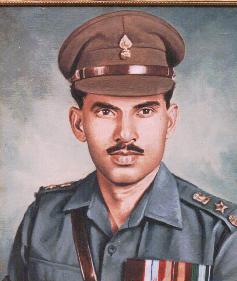
Major Hoshiar Singh was born on 05 May 1936 in Haryana. He was commissioned in the Grenadiers Regiment on 30 June 1963. He was also Mentioned-in-Despatches. During the 1971 Indo-Pak war, the 3rd Battalion of the Grenadiers Regiment spearheaded the advance of 54 Inf. Div. in Shakargarh sector on the western front on the night of December 5th. The 3rd Grenadiers made quick gains in the first ten days of the war. On December 15th, it was assigned the task of establishing a bridgehead across the Basantar river. The river was covered with deep minefields on both sides and protected by well-fortified defence by the enemy. Major Singh, Commander of 'C' Company, launched an attack across the enemy minefield on Jarpal from the left. It was a well-fortified position held in good strength by the enemy. The company came under intense shelling and crossfire from enemy medium machine guns and suffered heavy casualties.
The 3 Grenadiers, however, continued the assault doggedly and captured their objective. In this battle, most of the enemy bunkers could be cleared only after grim hand-to-hand fighting. The enemy's reaction to the loss of Jarpal was violent. They put in sharp counter attacks, two of them supported by armour, to dislodge the 4 Grenadiers on December 16th. Major Singh, unmindful of the enemy shelling and tank fire, went from trench to trench, encouraging his men to remain steadfast and fight. Inspired by his courage and leadership, his company repulsed all attacks, inflicting heavy casualties on the enemy. On December 17th, the enemy mounted yet another attack in battalion strength with heavy artillery in support. Though wounded seriously in enemy shelling, Major Singh again went alone from trench to trench, moving in the open. On one occasion an enemy shell landed near his medium machine gun post, injuring the crew and rendering the gun inoperative. Major Singh, realising the importance of fire support at this juncture, rushed to the machine gun pit and operated the gun inflicting heavy casualties on the enemy.
The enemy attack was repulsed, and they beat a hasty retreat leaving behind 85 dead, including their Commanding Officer - Lieutenant Colonel Mohammed Akram Raja and three other officers. Throughout this operation, Major Singh displayed the most conspicuous gallantry in the face of the enemy, grim determination and indomitable spirit. His dogged resistance, complete disregard to his personal safety and cool courage so inspired his command that they performed outstanding acts of gallantry and defeated repeated enemy attempts to recapture the locality. The steadfastness and dauntless courage displayed by Major Hoshiar Singh were in keeping with the highest traditions of the Army, and his refusal to be evacuated despite his serious wounds was an act beyond the call of duty. He was honoured with the highest wartime gallantry medal, Param Vir Chakra
CITATION
MAJOR HOSHIAR SINGH
3 GRENADIERS (IC-14608)
On 15 December 1971 a battalion of the Grenadiers was given the task of establishing a bridgehead across the Basantar river in the Shakargarh Sector. Major Hoshiar Singh was commanding the left forward company and he was ordered to capture the enemy locality of Jarpal. This was a well-fortified position and was held in strength by the enemy. During the assault, his company came under intense shelling and effective crossfire from enemy medium machine guns. Undeterred, he led the charge and captured the objective after a fierce hand-to hand fight. The enemy reacted and put in three counter attacks on 16 December 1971, two of them supported by armour, Major Hoshiar Singh unmindful of the heavy shelling and tank fire went from trench to trench, motivating his command and encouraging his men to stand fast and fight. Inspired by his courage and dauntless leadership, his company repulsed all the attacks inflicting heavy casualties on the enemy. Again, on 17 December 1971 the enemy made another attack with a battalion supported by heavy artillery fire. Though seriously wounded by enemy shelling, Major Hoshiar Singh again went from trench to trench moving about in the open with utter disregard to his personal safety when an enemy shell landed near the medium machine gun post injuring the crew and rendering it inoperative. Major Hoshiar Singh, realizing the importance of machine-gun fire, immediately rushed to the machine-gun pit and though seriously wounded himself, manned the gun inflicting heavy casualties on the enemy. The attack was successfully repulsed and the enemy retreated leaving behind 85 dead including their Commanding Officer and three other officers. Though seriously wounded, Major Hoshiar Singh refused to be evacuated till the ceasefire.
Throughout this operation, Major Hoshiar Singh displayed most conspicuous gallantry, indomitable fighting spirit and leadership in the highest traditions of the Army.
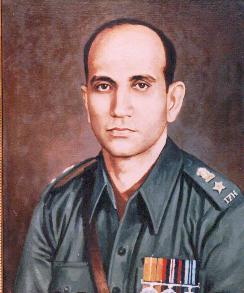
Lieutenant Colonel Ardeshir Burzarji Tarapore was born on 18 August 1923 in Bombay , Maharashtra . He joined the Hyderabad State Force in 1942 and saw active service in West Asia during World War-II. He was commissioned in Poona Horse on 01 April 1951. The biggest tank battle of the 1965 Indo-Pak War took place at Phillora in the Sialkot sector. During the southern thrust of the Indian Army on the Kaloi-Phillora axis the 17 Horse commanded by Lt. Col. A B Tarapore advanced on the right flank. On 11 September 1965, the regiment was assigned the task of delivering the main armoured thrust for capturing Phillora. It decided upon launching a surprise attack on Phillora from the rear. To achieve the surprise, when the regiment was thrusting forward between Phillora and Chawinda, it was suddenly counter-attacked by the enemy's heavy armour from Wazirali.
Lt. Col. A B Tarapore defied the enemy's charge, held his ground and gallantly attacked Phillora with one of his squadrons supported by an Infantry battalion. Though under continuous enemy tank and artillery fire, he remained unperturbed throughout this action. When wounded, he refused to be evacuated. On 14 September 1965, he led his regiment to capture Wazirali. Unmindful of his injury, he again led his regiment and captured Jassoran and Butur-Dograndi on 16 September 1965. In this battle his own tank was hit several times. But despite the odds, he maintained his pivots at both these places and thereby helped the supporting infantry to attack Chawinda from the rear. Inspired by his leadership, the regiment fiercely attacked the enemy armour and destroyed approximately sixty enemy tanks, suffering only nine tank casualties. However, Lt. Colonel A B Tarapore tank was in flames and he died a hero's death. The valour displayed by him in this action, lasting 6 days, was in keeping with the highest traditions of the Indian Army. Lieutenant Colonel Ardeshir Burzarji Tarapore was awarded with the highest war-time gallantry medal, Param Vir Chakra, posthumously.
CITATION
LIEUTENANT COLONEL A.B TARAPORE,
POONA HORSE (17 HORSE) (IC-5565)
On 11 September 1965, the Poona Horse Regiment under the command of Lieutenant Colonel Ardeshir Burzarji Tarapore was assigned the task of delivering the main armoured thrust for capturing Phillora in the Sialkot Sector in Pakistan . As a preliminary to making a surprise attack on Phillora from the rear, the regiment was thrusting between Philloira and Chawinda when it was suddenly counter attacked by the enemy’s heavy Armour from Wazirali. Lieutenant Colonel A. B. Tarapore who was then at the head of his regiment, defied the enemy’s charge, held his ground and gallantly attacked Philloira with one of his squadrons supported by an infantry battalion. Though under continuous enemy tank and artillery fire, Lieutenant Colonel A B Tarapore remained unperturbed throughout this action and when wounded refused to be evacuated.
On 14 September 1965, though still wounded he again led his regiment to capture Wazirali. Such was his grit and determination that unmindful of his injury, he again gallantly led regiment and captured Jassoran and Butur-Dograndi on 16 September. His own tank was hit several times, but despite the odds he maintained his pivots in both these places and thereby allowed the supporting infantry to attack Chawinda from the rear.
Inspired by his leadership, the regiment fiercely attacked the enemy heavy armour destroying approximately 60 enemy tanks at a cost of only 9 tank casualties, and when lieutenant Colonel A. B Tara pore was mortally wounded the regiment continue to defy the enemy.
The valour displayed by lieutenant Colonel A.B. Tarapore in this heroic action, which lasted six days, was in keeping with the highest traditions of the Indian Army.
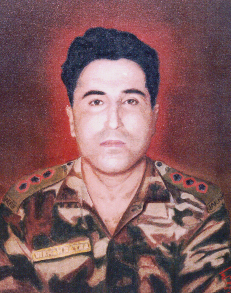
Captain Vikram Batra, 13 JAK Rifles, and his Delta Company was given the task of recapturing Point 5140. Nicknamed Sher Shah for his unstinting courage, he decided to lead the attack from the rear as an element of surprise would help stupefy the enemy. He & his men ascended the sheer rock-cliff and as the group neared the top, the enemy opened machine gun fire on them, pinning them on to the face of the bare rocky cliff. Captain Batra along with five of his men climbed on regardless and after reaching the top, hurled two grenades at the machine gun post. He single handedly engaged three enemy soldiers in close combat and killed them. He was seriously injured during this combat, but insisted on regrouping his men to continue with the given task at hand. Inspired by the extraordinary courage displayed by Captain Batra, the soldiers of 13 JAK Rifles charged the enemy position and captured Point 5140 at 3:30 a.m. on 20 June 1999. His company is credited with killing at least 8 Pakistani soldiers and recovering a heavy machine gun.
The capture of Point 5140 set in motion a string of successes like Point 5100, Point 4700, Junction Peak and Three Pimples. Captain Batra led his men to even more glorious victories with the recapture of Point 4750 and Point 4875. He was tragically killed, when he tried to rescue an injured officer during an enemy counterattack against Point 4875 in the early morning hours of 07 July 1999. His last words were, "Jai Mata Di." For his sustained display of the most conspicuous personal bravery and junior leadership of the highest order in the face of the enemy, Captain Vikram Batra was awarded the Param Vir Chakra, India's highest medal for gallantry, posthumously. His father, Mr. G.L. Batra, received the award from the President of India, on behalf of his brave son.
13 JAMMU AND KASHMIR RIFLES (IC 57556)
During ‘Operation Vijay’, on 20 June 1999, Captain Vikram Batra, Commander Delta Company was tasked to attack Point 5140. Captain Batra with his company skirted around the feature from the East and maintaining surprise reached within assaulting distance of the enemy. Captain Batra reorganized his column and motivated his men to physically assault the enemy positions. Leading from the front, he in a daredevil assault, pounced on the enemy and killed four of them in a hand-to hand fight. On 7 July 1999, in another operation in the area Pt 4875, his company was tasked to clear a narrow feature with sharp cuttings on either side and heavily fortified enemy defences that covered the only approach to it. For speedy operation, Captain Batra assaulted the enemy position along a narrow ridge and engaged the enemy in a fierce hand –to-hand fight and killed five enemy soldiers at point blank range. Despite sustaining grave injuries, he crawled towards the enemy and hurled grenades clearing the position with utter disregard to his personal safety, leading from the front, he rallied his men and pressed on the attack and achieved a near impossible military task in the face of heavy enemy fire. The officer, however, succumbed to his injuries. Inspired by his daredevil act, his troops fell upon the enemy with vengeance, annihilated them and captured Point 4875.
Captain Vikram Batra, thus, displayed the most conspicuous personal bravery and leadership of the highest order in the face of the enemy and made the supreme sacrifice in the highest traditions of the Indian Army.
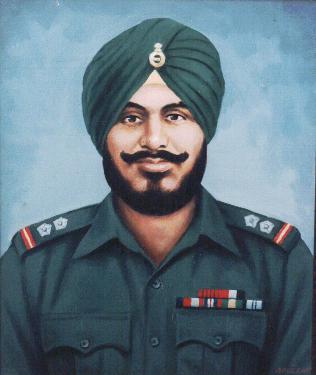
Subedar Joginder Singh, was born on 26 September 1921, in Faridkot, Punjab . On 28 September 1936, he was enrolled in the 1 Sikh Regiment. During the 1962 Indo-China War, Subedar Joginder Singh commanded a platoon in the Tawang sector of NEFA (North East Frontier Agency). While holding a defensive position on a ridge in Tongpeng La area on Bum La axis, the platoon noticed heavy enemy concentration opposite Bum La across the McMohan Line on October 20th. This was indeed a preparatory to the Chinese advance on Bum La axis on October 23rd.
At 0530 hours on October 23rd, the Chinese launched a heavy attack on the Bum La axis. The intention was to achieve a breakthrough to Tawang. The enemy attacked the Ridge in three waves, each about 200 strong. The attack was supported by artillery and mortar fire, besides other weapons. The fierce resistance of the Sikh platoon, however, compelled the enemy to fall back with heavy losses. But he regrouped quickly and launched a fresh attack under the cover of an artillery barrage. However, Subedar Joginder Singh and his platoon stood firm like a rock before the advancing enemy. In this fierce action, the platoon lost half of its men but not the will to fight. Subedar Joginder Singh, despite a wound in the thigh, refused evacuation. His platoon also refused to yield any ground to the enemy. The last wave of the Chinese attack, which was more determined and more forceful followed next. Now the platoon had very few men left to fight. Subedar Joginder Singh, therefore, manned a light machine gun and killed a large number of enemies.
But he could not stem the tide of the enemy advance single-handedly. The Chinese Army continued advancing with little concern for the casualties. By now all ammunition with the platoon had been exhausted. When the situation became desperate, Subedar Joginder Singh and his men emerged from their position with fixed bayonets, shouting the Sikh battle cry, "Wahe Guruji ka Khalsa, Wahe Guruji ki Fateh." They fell upon the advancing enemy and bayoneted many to death. Finally better weapons and numerical superiority of the enemy prevailed and Subedar Singh was killed in this epic battle. For his inspiring leadership, courage and devotion to duty, Subedar Joginder Singh was awarded the highest wartime gallantry medal, the Param Vir Chakra, posthumously.
CITATION
SUBEDAR JOGINDER SINGH
1 SIKH (JC 1547)
Subedar Joginder Singh was the commander of a platoon of the Sikh Regiment holding a defensive position at a ridge near Tongpen La in NEFA. At 0530 hours on 23 October 1962, the Chinese opened a very heavy attack on the Bumla axis with the intention of breaking through to Towang. The leading battalion of the enemy attacked the ridge in three waves, each about 200 strong. Subedar Joginder Singh and his men mowed down the first wave, and the enemy was temporarily halted by the heavy losses it suffered. With in a few minutes, a second wave came over and was dealt with similarly. But the platoon had, by then, lost half its men.
Subedar Joginder Singh was wounded in the thigh but refused to be evacuated. Under his inspiring leadership the platoon stubbornly held its ground and would not withdraw.
Meanwhile the position was attacked for the third time. Subedar Joginder Singh himself manned a light machine-gun and shot down a number of the enemy. The Chinese however continued to advance despite heavy losses. When the situation became untenable Subedar Joginder Singh and the few men that were left in the position fixed bayonets and charged the advancing Chinese, bayoneting a number of them before he and his comrades were overpowered. Throughout this action, Subedar joginder Singh displayed devotion to duty, inspiring leadership and bravery of the highest order.
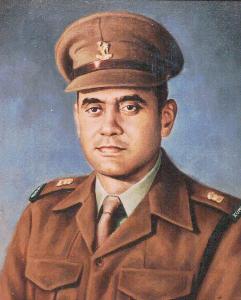
Major Shaitan Singh, son of Lieutenant Colonel Hem Singhji, was commissioned in the Kumaon Regiment on 01 August 1949. During the 1962 Indo-China conflict, 13 Kumaon was deployed in Chusul sector. The C Coy of the battalion led by Major Shaitan Singh held a crucial position at Rezang La, at a height of 5000 metres. The company area was defended by five platoon positions and the surrounding terrain isolated it from the rest of the battalion. The expected Chinese attack on Rezang La came on November 18th in the morning. It was the end of a very cold winter night. The icy winds howling through Rezang La were biting and benumbing. In the dim light of the morning, the Chinese were seen advancing through nullahs to attack No.7 and No.8 platoon positions.
The Indian troops fell on their prepared positions to face the enemy offensive. At 0500 hours when the visibility improved both platoons opened up on the advancing enemy with rifles, light machine guns, grenades and mortars. The nullahs were littered with dead bodies. The survivors took position behind boulders and the dead bodies. The enemy was not, however, discouraged. They subjected Indian positions to intense artillery & mortar fire at about 0540 hours. Soon about 350 Chinese troops commenced advance through the nullahs. This time, No.9 Platoon, which held fire till the enemy was within 90 meters opened up with all weapons in their possession. Within minutes, the nullahs were again full of dead bodies.
Unsuccessful in frontal attack, the enemy, approximately 400 strong, then attacked from the rear of the company position. They simultaneously opened intense MMG (medium machine gun) fire on the No.8 Platoon. This attack was contained at the barbed wire fencing of the post. The enemy then resorted to heavy artillery and mortar shelling. An assault group of 120 Chinese also charged the No.7 Platoon position from the rear. However, Indian 3-inch mortar killed many of them. When 20 survivors charged the post, about a dozen Kumaonis rushed out of their trenches to engage them in a hand-to-hand combat. Meanwhile, the enemy brought up fresh reinforcements. The encirclement of the No.7 Platoon was now complete. The platoon, however, fought valiantly till there was no survivor. No.8 Platoon also fought bravely to the last man and last round.
Major Shaitan Singh, the Coy Commander, displayed exemplary leadership and courage in the battle of Rezang La. He led his troops most admirably. Unmindful of his personal safety he moved from one platoon post to another and encouraged his men to fight. While moving among the posts he was seriously wounded. But he continued to fight along with his men. While he was being evacuated by two of his comrades, the Chinese brought heavy machine gun fire on them. Major Shaitan Singh sensed danger to their lives and ordered them to leave him. They placed him behind a boulder on the slopes of a hill, where he breathed his last. In this action, 109 Kumaonis out of a total of 123 were killed. The Chinese suffered many more casualties. After the war was over, the body of Major Shaitan Singh was found at the same place. It was flown to Jodhpur and cremated with full military honours. Major Shaitan Singh was awarded Param Vir Chakra, the highest wartime gallantry medal, posthumously, for his leadership and devotion to duty.
CITATION
Major Shaitan singh
13 KUMAON (IC 7990
Major Shaitan singh was commanding a company of an infantry battalion deployed at Rezang La in the Chusul sector at a height of about 17,000 feet. The locality was isolated from the main defended sector and consisted of five platoon-defended position. On 18 November 1962, the Chinese forces subjected the company position to heavy artillery, mortar and small arms fire and attacked it in overwhelming strength in several successive waves. Against heavy odds, our troops beat back successive waves of enemy attack. During the action, Major Shaitan singh dominated the scene of operations and moved at great personal risk from one platoon post to another sustaining the morale of his hard-pressed platoon posts. While doing so he was seriously wounded but continued to encourage and lead his men, who, following his brave example fought gallantly and inflicted heavy casualties on the enemy. For every man lost to us, the enemy lost four or five. When major Shaitan Singh fell disabled by wounds in his arms and abdomen, his men tried to evacuate him but they came under heavy machine-gun fire. Major Shaitan Singh then ordered his men to leave him to his fate in order to save their lives.
Major Shaitan Singh’s supreme courage, leadership and exemplary devotion to duty inspired his company to fight almost to the last man.
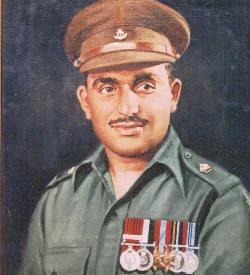
Major Somnath Sharma, son of Major General Amarnath Sharma, was born on 31 January 1923, in Jammu. He was commissioned in the Kumaon Regiment on 22 February 1942. During the Second World War, he had fought in the Arakan Operations. His brother, General V.N. Sharma, served as the Chief of Army Staff during 1988 to 1990. On 22 October 1947, Pakistan launched the tribal invasion of Jammu & Kashmir. The intention was to grab the Kashmir valley by force. As the State became a part of the Union on October 26th, her protection became the responsibility of India . To save the State from a tribal invasion, which was approaching the valley at a very fast pace, India dispatched troops to Srinagar . The first batch of Indian troops reached just in time on October 27th morning to stop the enemy on the outskirts of Srinagar .
The D Company of 4 Kumaon, led by Major Somnath Sharma, was airlifted to Srinagar on October 31st. When his company was asked to move to Srinagar , Major Sharmas arm was in plaster. He had suffered a fracture on the hockey ground and was advised rest till the plaster was removed. But he insisted on being with his company at this crucial hour and was allowed to go. Meanwhile, the 1 Sikh at Patan had blunted the main thrust of the tribal invasion of Srinagar . The enemy now resorted to guerilla tactics to sneak into the valley. But the induction of more troops into Srinagar enables the Army to take care of the surrounding areas better. On November 3rd, a strong fighting patrol comprising 3 companies was dispatched to reconnoiter the Bagdam area to look for raiders approaching Srinagar from the northern direction. By 0930 hrs the troops had established a firm base at Bagdam.
As no enemy was seen during patrolling, two companies moved back to Srinagar by 1400 hrs. D Coy led by Major Sharma, which had taken up position south of Bagdam, was, however, asked to stay on in the area till 1500 hours. At 1435 hours, D Coy was subjected to firing from some houses of Bagdam village. The Coy did not return fire for fear of killing innocent people of the village. While Major Sharma was discussing this threat with the Brigade Commander, a large force of the enemy, about 700 strong, appeared from a depression to the west of his position. It attacked the coy with small arms, mortars and heavy automatics. The accurate and devastating fire of the enemy inflicted heavy casualties on D Coy. Major Somnath Sharma understood the gravity of the situation and the imminent threat to both Srinagar town and the airfield was looming large before his eyes. He rushed across the open ground to his sections, exposing himself to enemy fire. He also laid out panels to guide IAF aircraft to their targets in the face of enemy fire. The company held on for six hours against heavy odds.
When heavy casualties adversely affected the firing power of the company, Major Sharma, with his right hand in plaster, took upon himself the task of filling the magazines and issuing them to men, operating light machine guns. While he was busy fighting the enemy, a mortar shell exploded on the ammunition near him. His last message to Brigade HQ, received a few moments before he was killed was, "The enemy are only 50 yards from us. We are heavily outnumbered. We are under devastating fire. I shall not withdraw an inch but will fight to our last man and our last round." His answer is now part of the Army lore. In the battle of Bagdam, Major Sharma, one JCO and 20 other ranks were killed. But their sacrifices did not go in vain. He and his men stemmed the tide of the enemy advance on Srinagar and the airfield for some very crucial hours. He has set an example of courage and qualities, seldom equaled in the history of the Indian Army. Major General Amarnath Sharma received India s first and highest wartime gallantry medal, Param Vir Chakra, on behalf of his brave son.
CITATION
Maj Somnath Sharma
4 KUMANON (IC-521)
On 3 November 1947, Major Somnath Sharma’s company was ordered on a fighting patrol to Badgam in the Kashmir Valley . He reached his objective at first light on 3 November and took up a position south of Badgam at 1100hours. The enemy, estimated at about 500 attacked his company position from three sides; the company began to sustain heavy casualties.
Fully realizing the gravity of the situation and the direct threat that would result to both the aerodrome and Srinagar via Hum Hom, Major Somnath Sharma urged his company to fight the enemy tenaciously. With extreme bravery he kept rushing across the open ground to his sections exposing himself to heavy and accurate fire to urge them to hold on.
Keeping his nerve, he skillfully directed the fire of his sections into the ever-advancing enemy. He repeatedly exposed himself to the full fury of enemy fire and laid out cloth strips to guide our aircraft onto their targets in full view of the enemy.
Realising that casualties had affected the effectiveness of his light automatics, this officer whose left hand was in plaster, personally commenced filling magazines and issuing them to the light machine gunners. A mortar shell landed right in the middle of the ammunition resulting in an explosion that killed him.
Major Sharma’s company held on to list position and the remnants withdrew only when almost completely surrounded. His inspiring example resulted in the enemy being delayed for six hours, thus gaining time for our reinforcements to get into position at Hum Hom to stem the tide of the enemy advance.
His leadership, gallantry and tenacious defence were such that his men were inspired to fight the enemy by seven to one, six hours after this gallant officer had been killed.
He has set an example of courage and qualities seldom equalled in the history of the Indian Army. His last message to the Brigade Headquarters a few moments before he was killed was, ‘the enemy are only 50 yards from us. We are heavily outnumbered. We are under devastating fire. I shall not withdraw an inch but will fight to the last man and the last round.’
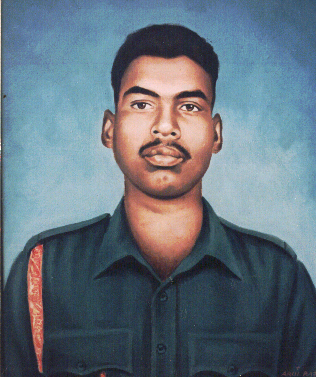
Lance Naik Albert Ekka, was born on 27 December 1942 in Ranchi , Bihar . He was enrolled in the 14 Guards on 27 December 1962. During the 1971 Indo-Pak War, the 14 Guards was asked to capture a Pakistani position at Gangasagar, 6½ km west of Agartala in the eastern sector. It was a well-fortified position, held in good strength by the enemy. The reduction of this position was considered necessary, as it was the key to the capture of Akhaura. The 14 Guards launched an attack on enemy positions at 0400 hours on 4 December 1971. Lance Naik Albert Ekka went with the left forward company of the battalion in the attack. The assaulting Indian troops were subjected to intense shelling and small arms fire by the enemy.
Lance Naik Albert Ekka observed that an enemy light machine gun was belching deadly fire from a bunker, causing heavy casualties to his company. Unmindful about his personal safety, he charged the enemy bunker, bayoneted two enemy soldiers and silenced the light machine gun. Though seriously injured in this encounter, he continued to fight alongside his comrades with courage, securing bunker after bunker. After battling through a distance of 1½ km, when Lance Naik Albert Ekka and his comrades reached the northern end of the objective, an enemy medium machine gun opened up from the second floor of a well-fortified building. It inflicted heavy casualties on the Indian troops and help up their progress.
Once again Lance Naik Albert Ekka, rose to the occasion. Unmindful of his personal safety, he crawled to the building and hurled a grenade into the bunker. One enemy soldier was killed and the other injured. But the MMG could not be silenced. Lance Naik Albert Ekka then scaled the sidewall to enter the bunker. He bayoneted the enemy holding the bunker and silenced the deadly weapon. This saved his company from further casualties and ensured success. Lance Naik Albert Ekka died of the injuries suffered during this battle. As a result of the fall of Gangasagar, the southern and southwestern flanks of Akhaura were exposed and the enemy rear was threatened. Consequently the enemy was forced to vacate Akhaura. Lance Naik Albert Ekka was awarded Param Vir Chakra, the highest wartime gallantry medal, posthumously, for displaying the conspicuous bravery and determination.
LANCE NAIK ALBERT EKKA
14 GUARDS (NO 4239746)
Lance Naik Albert Ekka was in the left forward company of a battalion of the Brigade of Guards during their attack on the ememy defences at Gangasagar on the Eastern front. This was a well-fortified position held in strength by the enemy. The assaulting troops were subjected to intense shelling and heavy small-arms fire, but they charged onto the objective and were locked in bitter hand-to-hand combat. Lance Naik Albert Ekka noticed an enemy light machine-gun (LMG) inflicting heavy casualties on his company. With complete disregard fo his personal safety, he charged the enemy bunker, bayoneted two enemy soldiers and silenced the LMG. Though seriously wounded in this encounter, he continued to fight alongside his comrades through the mile deep objective, clearing bunker after bunker with undaunted courage. Towards the northern end of the objective one enemy medium machine-gun (MMG) opened up from the second storey of a well-fortified building inflicting heavy casualties and holding up the attack. Once again this gallant soldier, without a thought for his personal safety, despite his serious injury and the heavy volume of enemy fire, crawled forward till he reached the building and lobbed a grenade into the bunker killing one enemy soldier and injuring the other. The MMG however continued to fire. With outstanding courage and determination Lance Naik Albert Ekka scaled a side wall and entering the bunker, bayoneted the enemy soldier who was still firing and thus silenced the machine-gun, saving further casualties to his company and ensuring the success of the attack. In this process however, he received serious injuries and succumbed to them after the capture of the objective.
In this action, Lance Naik Albert Ekka displayed the most conspicuous valour and determination and made the supreme sacrifice in the best traditions of the Army.
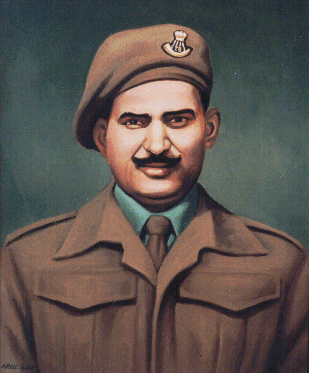
Company Havildar Major Piru Singh was born on 20 May 1918 in Rajasthan. He was enrolled in the 6 Rajputana Rifles on 20 May 1936. During the Jammu & Kashmir operations in summer of 1948, Pakistani raiders mounted a strong counter offensive in the Tithwal sector. The enemy also forced the Indian Army to vacate their forward positions across river Kishanganga. After the setback, Indian troops took position on the Tithwal ridge. At this juncture, 6 Rajputana Rifles was moved from Uri to Tithwal to strengthen the 163 Bde in its impending offensive in the sector. The Indian offensive commenced on 11 July 1948. The operation went on well till July 15th. The reconnaissance reports, however, revealed that the enemy was holding a high feature in the area and that its capture was essential for making any further progress. Further ahead lay another feature also held in strength by the enemy.
The 6 Rajputana Rifles was assigned the task of securing these two features. The ‘D’ Company was to secure the first feature. The ‘C’ Company was to capture the second feature after the ‘D’ Company had carried out its task. The ‘D’ Company launched its attack on the objective at 0130 hrs on July 18th. The path to the objective was about one metre wide with deep ravines on either side. Overlooking this narrow path were the hidden enemy bunkers. The company was subjected to heavy fire and with half an hour it suffered 51 casualties. During this battle, CHM Piru Singh was with the leading section of the company, more than half of which was mowed down by the devastating fire of the enemy. He rushed forward to deal with the enemy medium machine gun post, which was playing havoc with his troops. Enemy grenade splinters ripped open his clothes and wounded several parts of his body. But this did not deter him. He still continued the advance, shouting the battle cry, “Raja Ramchandra Ki Jai”. Rushing forward he bayoneted the crew of the enemy MMG, with his own sten gun, silenced the menacing gun and occupied the post. By this time all his companions lay behind either dead or wounded.
The responsibility of clearing the enemy from the hill feature lay with him alone. Bleeding profusely he inched forward to attack the second enemy MMG post. At this juncture a grenade wounded him in the face. The blood dripping from his face almost blinded him. By now all the sten gun ammunition with him had been spent. He courageously crawled out of the occupied enemy trench and hurled grenades at the next enemy post. CHM Piru Singh then jumped into another trench and bayoneted two enemy soldiers to death. As CHM Piru Singh, emerged out of the second trench to charge on the third enemy bunker, he was hit in head by a bullet and was seen dropping on the edge of the enemy trench. There was an explosion in the trench, which showed that the grenade had done its work. By then CHM Piru Singh’s wound had proved fatal. “He paid with his life for his singularity brave act, but he left for the rest of his comrades a unique example of single-handed bravery and determined cold courage. The country is grateful,” wrote Prime Minister Jawaharlal Nehru to Mrs. Tarawati, 75-year old mother of Company Havildar Major Piru Singh, “for this sacrifice made in the service of the Motherland, and it is our prayer that this may give you some peace and solace.” Company Havildar Major Piru Singh was honoured with the highest wartime gallantry medal, Param Vir Chakra, posthumously.
South of Tithwal, ‘D’ Company, of which No 2831592 Piru Singh, was Havildar Major was detailed to attack and capture an enemy occupied hill feature. The enemy had well dug in positions and had sited his MMGs so as to cover all possible approaches. As the attack advanced, it was met with heavy MMG fire from both flanks. Volleys of grenades were hurled down from enemy bunkers. Company Havildar Major Piru Singh was then with the forward most Section of the company.
Seeing more than half of the Section killed or wounded, he did not lose courage. With battle cries he encouraged the remaining men and rushed forward with great determination onto the nearest enemy MMG position. Grenade splinters ripping his clothes and wounding him at several places, he continued to advance without the least regard for his safety. He was on top of the MMG position wounding the gun crew with Sten gun fire. With complete disregard to his bleeding wounds he made a mad jump on the MMG crew bayoneting them to death, thus silencing the gun.
By then he suddenly realized that he was the sole survivor of the section, the rest of them either dead or wounded. Another grenade thrown at him wounded him in the face. With blood dripping from his face wounds in his eyes, he crawled out of the trench, hurling grenades at the next enemy position.
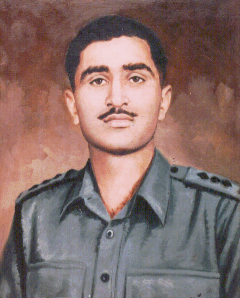
Captain Gurbachan Singh Salaria, was born on 29 November 1935, in Gurdaspur, Punjab . He was commissioned in the 1 Gorkha Rifles on 9 June 1957. After the Belgians quit Congo , a civil war situation developed in that country. When the United Nations decided upon military intervention to retreive the situation, India contributed a brigade of around 3000 men to the U.N. Force. In November 1961, the U.N. Security Council had decided to put a stop to the hostile activities of the Katangese troops in Congo . This greatly angered Tshombe , Katanga 's secessionist leader, and he intensified his 'hate the UN' campaign. The result was more violence against UN personnel. On 5 December 1961, a 3/1 GR Company supported by 3-inch mortar attacked a road-block, established by the Katangese troops, between HQ Katanga command and the Elizabethville airfield at a strategic round about. The enemy roadblock was destroyed and the Gorkhas established a UN roadblock there.
When Captain Salaria in platoon strength tried to link up with the Gorkha Company to reinforce the roadblock, he met strong opposition in the old airfield area. The enemy brought down heavy automatic and small arms fire on his force from a dug-in position on the right flank. The enemy held the area strongly with two armoured cars and 90 men. Captain Salaria was not deterred by the superior enemy strength and firepower. He decided to take the enemy, head-on, to achieve the objective. The Gorkhas then charged the enemy with bayonets, khukris and hand-grenades. A rocket launcher supported them in the attack. In this sharp encounter, Captain Salaria and his men killed 40 of the enemy and knocked out two enemy cars. His bold action completely demoralised the enemy who fled despite numerical superiority and well-fortified positions. However, in the engagement, Captain Salaria was wounded in the neck by a burst of enemy automatic fire, but he ignored the injury and continued to fight till he collapsed due to excessive bleeding.
Subsequently, he died of his grave wounds. Captain Salaria prevented the enemy from going to the roundabout thereby saving the UN Headquarters in Elizabethville from encirclement. His leadership, courage, unflinching devotion to duty and disregard for his personal safety were in the best traditions of the Indian Army. For his extraordinary leadership and devotion to duty, Captain Gurbachan Singh Salaria was awarded the highest wartime medal, Param Vir Chakra, posthumously.
CITATION
CAPTAIN GURBACHAN SINGH SALARIA
3/1 GORKHA RIFLES (IC-8947)
On 5 December 1961, 3/1 Gorkha Rifles was ordered to clear a roadblock established by the gendarmerie at a strategic roundabout at Elizabethville , Katanga . The plan was that one company with 2 Swedish armoured cars would attack the position frontally and Captian Gurbachan Singh Salaria with two sections of Gorkhas and two Swedish armoured personnel carriers would advance towards this roadblock from the airfield to act as a cutting-off force.
Captain Salaria with his small force arrived at a distance of 1500 yards from the roadblock at approximately 1312 hours on 5 December 1961 and came under heavy automatic and small-arms fire from an undetected enemy position dug in on his right flank. The enemy also had two armoured cars and about 90 men opposing Captain Salaria’s small force.
Captain Salaria appreciating that he had run into a subsidiary roadblock and ambush and that this enemy force might reinforce the strategic roundabout and thus jeopardize the main operation, decided to remove this opposition. He led a charge with bayonets, khukris, and grenades supported by a rocket launcher. In this gallant engagement, Captain Salaria killed 40 of the enemy and knocked out the two armoured cars. This unexpected bold action completely demoralised the enemy who fled despite their numerical superiority and protected positions.
Captain Salaria was wounded in his neck by a burst of automatic fire but continued to fight till he collapsed due to profuse bleeding. Captain Salaria’s gallant action prevented any enemy movement of the enemy force towards the main battle scene and thus contributed very largely to the success of the main battalion’s action at the roundabout and prevented the encirclement of UN Headquarters in Elizabethville. Captain Salaria subsequently died of his wounds.
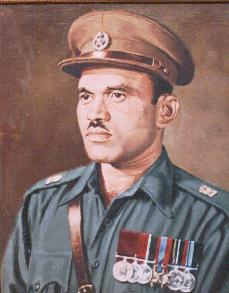
2nd Lieutenant Rama Raghoba Rane, was born on 26 June 1918 at Chendia, Karnataka. He was commissioned in the Corps of Engineers on 15 December 1947. He retired as a Major in 1968. During his 21 years' service with the Army, he earned five M-in-D (Mentioned-in-Dispatches). He served with distinction during the 1947-48 Jammu & Kashmir operations. On 18 March 1948, the Indian Army recaptured Jhangar, which was lost to the enemy in December 1947. Indian troops then planned an advance from Naushahra to Rajouri to protect the natives from atrocities of the raiders. Halfway lay the Chingas, on the old Mughal route to Kashmir . The 4 Dogra commenced the advance to Rajauri on 8 April 1948. It attacked the Barwali ridge, 11 km north of Naushahra and captured it after driving out the enemy from well-prepared positions. But beyond Barwali, the increasing number of roadblocks & minefields obstructed the progress of the battalion. Even armour could not cross over these obstacles. During this critical phase, 2nd Lt. Rane and his section of 37 Assault Field Company, attached to 4 Dogra, performed yeoman service. As the section started clearing a minefield on April 8th, two sappers were killed and five others including Rane were injured in enemy mortar fire. However, Rane and his men completed the work by the evening and enabled the tanks to push forward.
But the enemy had not been cleared from the area and road ahead was still unsafe for the advance. 2nd Lieutenant Rane worked during the night to prepare a safe lane for the tanks. On April 9th, his men continuously worked for twelve hours to clear mines and remove roadblocks. Where the road was found un-negotiable he made a diversion for the column to pass through. 2nd Lieutenant Rane continued this work in the face of enemy artillery and mortar fire. On April 10th, he woke up early to resume work on the roadblock, which could not be cleared the previous night. He cleared this huge roadblock of 5 big pine trees, surrounded by mines and covered by intensive machine-gun fire, within two hours. The Army advanced another 13 km on this day before they encountered another major roadblock. The enemy pickets perched on the adjoining hills were guarding all approaches to this roadblock. 2nd Lieutenant Rane drove to the roadblock in a tank and crouching under it, blasted the block with mines. He thus opened the road before the end of the night. On April 11th, they worked for 17 hours to open the road to Chingas and beyond.
2nd Lt. Rane made a substantial contribution in facilitating the Indian advance on Rajouri. It cost the enemy about 500 dead and many more wounded. It also helped in saving many innocent lives in Chingas and Rajauri. The citation reads, "But for the grim determination and tireless diligence of 2nd Lieutenant Rane, who worked ceaselessly, our column could not have reached Chingas - an important feature which secured for us a vantage position to advance further." The gallant effort made by 2nd Lieutenant Rama Raghoba Rane during this critical advance to Rajauri earned him the highest wartime gallantry medal, Param Vir Chakra.
CITATION
SECOND LIEUTENANT RAMA RAGHOBA RANE
BOMBAY ENGINEER (SS-14246)
On 8 April 1948, Second Lieutenant Rama Raghoba Rane, Bombay Engineers, was ordered to be in charge of the mine and roadblock clearing party at Mile 26 on the Naushera-Rajouri road which passes through very hilly country.
At 1100 hours, on that date near Nadpur South, just as Second Lieutenant Rane and his party were waiting near the tanks to start the work of clearing the mines ahead, the enemy started heavy mortaring of the area, with the result that two men of the mine-clearing party were killed and five others including Second Lieutenant Rane were wounded. The officer at once reorganized his party and started work for the tanks to go on to their position. Throughout the day he was near the tanks under heavy enemy machine-gun and mortar fire.
After the capture of Barwali Ridge at about 1630 hours, although knowing that the enemy had not been completely cleared of the area, Second Lieutenant Rane took his party ahead and started making a diversion for the tanks to proceed. He worked on till 2200 hours that night in full view of the enemy and under heavy machine-gun fire.
On 9 April he again started work at 0600 hours and worked on till 1500hrs when the diversion was ready for the tanks to proceed. As the armoured column advanced, he got into the leading carrier and proceeded ahead. After proceeding about half a mile he came across a roadblock made of pine trees. He at once dismounted and blasted the trees away. The advance continued. Another 300 yards and the same story was repeated. By this time it was getting on to 1700 hours. The road was curving round the hill like a snake. The next roadblock was a demolished culvert. Second Lieutenant Rane again got on with the job. Before he could start work, the enemy opened up with their machine-guns, but with super courage and leadership he made a diversion and the column proceeded ahead. The roadblocks were becoming numerous but he blasted his way through. It was now 1815 hours, and light was fading fast. The carrier came across a formidable roadblock of five big pine trees surrounded by mines and covered by machine-gun fire. He started removing the mines and was determined to clear the roadblock but the armoured column commander appreciating the situation got the column into a harbour area.
On 10 April 1948 at 0445 hours, Second Lieutenant Rane again started work on the roadblock in spite of machine-gun fire with the support of one troops of tanks. With sheer will power he cleared this roadblock by 0630hours. The next thousand yards was a mass of roadblocks and blasted embankments. That was not all. The enemy had the whole area covered with machine-gun fire but with superhuman efforts, in spite of having been wounded, with cool courage and exemplary leadership and complete disregard for personal life, he cleared the road by 1030 hours.
The armoured column proceeded ahead and got off the road into the riverbed of the Tawi but Second Lieutenant Rane continued clearing the road for the administrative column. The tanks reached Chingas by 1400 hours. Second Lieutenant Rane appreciating that the opening of the road was most vital, continued working without rest or food till 2100 hours that night.
On 11 April 1948, he again started work at 0600 hours and opened the road to Chingas by 1100 hours. He worked on that night till 2200 hours clearing the road ahead.
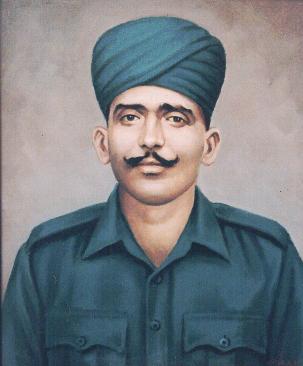
Naik Jadunath Singh, was born on 21 November 1916 in Shahjahanpur, Uttar Pradesh. He was enrolled in the 1 Rajput on 21 November 1941. During the Jammu & Kashmir operations in the winter of 1947, the capture of Jhangar on December 24th, by the Pakistani raiders, placed them in an advantageous position in the Naushahra sector. Being in full comand of the communication lines from Mirpur to Poonch, they could now build up their forces for attack on Naushahra. The Army was alive to this threat. In January 1948, they conducted operations to prevent the enemy build up in the area and in the process occupied Kot village to the Northwest of Naushahra. In any case an attack on Naushahra was imminent. Brigadier Usman of the 50 Para Brigade had made adequate preparation to thwart this attack by establishing strong pickets on possible enemy approaches. One of these approaches lay to the north of Naushahra through Tain dhar.
The expected enemy attack came on the foggy morning of February 6th, at 0640 hrs. The enemy started the attack by opening fire from their pickets on the Taindhar ridge on an Indian patrol. Simultaneously, the whole of Tain dhar and the surrounding hills became live with bursts of machine gun and crunches of mortar fire. Meanwhile under the cover of darkness the enemy crept up to the Indian pickets. In the first light of dawn the men on the post saw thousands of hostiles creeping up to them. On the crucial day of February 6th, Naik Jadunath Singh was in command of a forward post of picket No.2 at Taindhar. 9 men garrisoned the post.
The enemy launched their attack in successive waves to take this post. At this juncture Naik Jadunath Singh displayed great valour & superb leadership and used his small force in such a manner that the enemy retreated in utter confusion. When four of his men were wounded he re-organised the battered force for meeting another onslaught. The post did not give in despite its being outnumbered. When all men including him were wounded, he personally took over the bren gun from the wounded bren-gunner. The enemy was now right on the walls of the post. Naik Jadunath Singh, unmindful of personal safety encouraged his men to fight. His fire was so devastating that what looked like a certain defeat was turned into a victory. Thus the post was saved a second time.
By now all men of the post had turned into casualties. The enemy put in his third and final attack determined to capture the post. Naik Jadunath Singh, wounded and alone, rose to give a battle for the third time. He came out of the Sangar and firing his sten gun charged on the advancing enemy. The surprised enemy fled in disorder. He met a gallant death, in this third and last charge, when two enemy bullets pierced him in the head and the chest. At a most critical stage in the battle for the defence of Naushahra, he saved his picket from being overrun by the enemy. Naik Jadunath Singh was honoured with the highest wartime gallantry medal, Param Vir Chakra, posthumously.
CITATION
NAIK JADUNATH SINGH
1 RAJPUT (NO 27373)
At No 2 picquet on Taindhar on 6 February 1948, No 27373 Naik Jadunath Singh was in command of a forward section post, which bore the full brunt of the enemy attack. Nine men against overwhelming odds garrisoned the little post. The enemy launched its attack in successive waves and with great ferocity to overcome this post. The first wave swept up to the post in a furious attack. Displaying great valour and superb qualities of leadership Naidk Jadunath Singh so used the small force at his disposal that the enemy retired in utter confusion. Four of his men were wounded but Naik Jadunath Singh again showed his qualities of good leadership by reorganizing the battered force under him, for meeting another onslaught. His coolness and courage were of such an order that the men rallied and were ready for the second attack which came with greater determination and in larger number than the preceding one. Though hopelessly outnumbered, this post under the gallant leadership of Naik Jadunath Singh resisted. All were wounded, and Naik Jadunath Singh, though wounded in the right arm, personally took over the Bren gun from the wounded Bren gunner. The enemy was right on the walls of the post but Naid Jadunath Singh once again showed outstanding ability and valour of the highest order in action. By his complete disregard for his personal safety and example of coolness and courage, he encouraged his men to fight. His fire was so devastating, that what looked like impending defeat was turned into a victory and the enemy retreated in chaos leaving the dead and wounded littered on the ground. With this act of supreme heroism and outstanding example of leadership and determination, Naik Jadunath Singh saved the post from the second assault. By this time, all men in the post were casualties. The enemy put in his third and final attack in undiminished numbers and determination to capture this post. Naik Jadunath Singh, now wounded, prepared literally single-handed to give battle for the third time. With great courage and determination, he came out of the sangar and finally with the Sten gun, made a most magnificent single-handed charge on the advancing enemy, who, completely taken by surprise, fled in disorder. Naik Jadunath Singh, however, met his gallant death in his third and last charge when two bullets hit him in the head and chest. Thus, charging single-handedly at the advancing enemy, this Non-Commissioned Officer, performed the highest act of gallantry and self-sacrifice and by so doing saved his section-nay, his whole picquet from being overrun by the enemy at the most critical stage in the battle for the defence of Nushera.
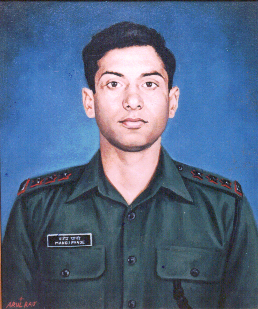
Lieutenant Manoj Kumar Pandey, 1/11 Gorkha Rifles, forced back the intruders from the Batalik sector on 11 June 1999. He led his men to recapture the Jaubar Top, a feature of great operational importance. But his finest hour was in the capture of Khalubar in the early morning hours of 3 July 1999. On the night of 2/3 July 1999 the battalion's progress on to its final objective, was halted by a determined enemy firmly entrenched on commanding heights. Clearing it was critical as the battalion faced the prospect of being day lighted in a vulnerable area. Lieutenant Pandey stepped forward to take on the mission. Quickly sizing up the situation, the young officer led his platoon along a narrow, treacherous ridge that led to the enemy position. While still short of the objective, the enemy fired upon the Indian soldiers effectively stalling the Indian attack. Displaying great courage, he surged ahead of his troops and charged at the enemy with a full-throated battle cry through a hail of bullets.
Although wounded in the shoulder and leg, he pressed on his solitary charge with grim determination, till he closed in on the first bunker. Then in ferocious hand-to-hand combat, he killed two of the enemy and cleared the first bunker. It was the turning point. Inspired by their leader's spontaneous valour, the troops charged at the enemy and fell upon them. Unmindful of his grievous wounds, he rushed from bunker to bunker urging his men. On critically bleeding, he collapsed at the final bunker and finally succumbed to his injuries, but not before the last of the enemy had been annihilated. His last words were, "Na Chodnu" (Don't Leave Them). For his sustained display of the most conspicuous personal bravery and junior leadership of the highest order in the face of the enemy, Lieutenant Manoj Kumar Pandey was awarded the Param Vir Chakra, India's highest medal for gallantry, posthumously. His father, Mr. Gopichand Pandey, received the award from the President of India, on behalf of his brave son.
(LIEUTENANT MANOJ KUMAR PANDEY)
Lieutenant Manoj Kumar Pandey took part in a series of boldly led attacks during ‘operation Vijay ', forcing back the intruders with heavy losses in Battlik including the capture of Jaubar Top. On the night of 2/3 July 1999 during the advance to Khalubar as his platoon approached its final objective, it came under heavy and intense enemy fire from the surrounding heights. Lieutenant Pandey was tasked to clear the interfering enemy positions to prevent his battalion from getting day lighted, being in a vulnerable position. He quickly moved his platoon to an advantageous position under intense enemy fire, sent one section to clear the enemy positions from the right and himself proceeded to clear the enemy positions from the left. Fearlessly assaulting the first enemy position, he killed two enemy personnel and destroyed the second position by killing two more. He was injured on the shoulder and legs while clearing the third position. Undaunted and without caring for his grievous injuries, he continued to lead the assault on the fourth position urging his men and destroyed the same with a grenade, even as he got a fatal burst on his forehead. This singular daredevil act of Lieutenant Manoj Kumar Pandey provided the critical firm base for the companies, which finally led to capture of Khalubar. The officer, however, succumbed to his injuries.
Lieutenant Manoj Kumar Pandey, thus, displayed most conspicuous bravery, indomitable courage, outstanding leadership and devotion to duty and made the supreme sacrifice in the highest traditions of the Indian Army.
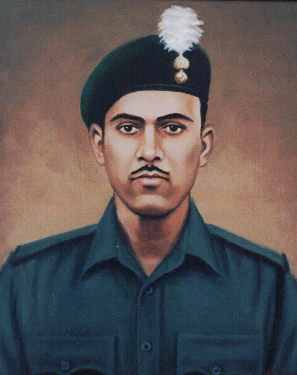
Company Quarter-Master Havildar Abdul Hamid was born on 1 July 1933, in Uttar Pradesh. He was enrolled in the 4 Grenadiers on 27 December 1954. During his Army service he earned the Sainya Seva Medal with Clasp J&K, the Samar Seva Medal and the Raksha Medal. During the 1965 Indo-Pak War, 4 Indian Division was entrusted with a two-fold responsibility - capture Pak territory East of Lchhogil Canal and contain possible enemy attack on Kasur-Khem Karan axis. The 4th Indian Division succeeded in reaching Ichhogil but the powerful Pakistani offensive forced it to fall back on Asal Uttar. The 4 Indian Division settled here to meet the enemy assault.
In the new defence plan of the Division, 4 Grenadiers occupied a vital area ahead of Chima village on the Khem Karan-Bhikhiwind road. A firm hold on this area was considered essential to sustain the divisional plan of defence. On September 8th night, the enemy made repeated probing attacks on Grenadiers positions but was frustrated in all the attempts. The most serious threat, however, developed when the enemy attacked with a regiment of Patton tanks at 0800 hours on September 10th. The attack was preceded by intense artillery shelling so much so that a shell littered every yard of ground occupied by the battalion.
By 0900 hours, the enemy tanks had penetrated the forward company positions. At this critical juncture, Hamid was commanding a recoilless gun detachment. Seeing the gravity of the situation, he moved out to a flank with his gun mounted on a jeep. Intense enemy shelling and tank fire did not deter him. From his new position, he knocked out the leading enemy tank with accurate fire. Then he changed his position and knocked out another enemy tank. By this time the enemy who had spotted his position brought down concentrated machine gun and high explosive fire on him.
But he kept on firing. As he fired to hit yet another enemy tank, he was mortally wounded by a high explosive shell. Throughout this action, CQMH Abdul Hamid inspired his comrades to put up a gallant fight to beat off the enemy tank assault. His sustained act of bravery and disregard for personal safety, in the face of constant enemy fire, were a shining example, not only to his unit but also to the whole division and were in the highest traditions of the Indian Army. Company Quarter Master Havildar Abdul Hamid was honoured with the highest war time gallantry medal, Param Vir Chakra, posthumously.
4 GRENADIERS (NO 2639985)
At 0800 hours on 10 September 1965 Pakistan forces launched an attack with a regiment of Patton tanks on a vital area ahead of village Cheema on the Bhikkiwind road in the Khem Karan Sector. Intense artillery shelling preceded the attack. The enemy tanks penetrated the forward position by 0900 hours. Realising the grave situation, Company Quartermaster Havildar Abdul Hamid who was commander of a RCL gun detachment moved out to a flanking position with his gun mounted on a jeep, under intense enemy shelling and tank fire. Taking an advantageous position, he knocked out the leading enemy tank and then swiftly changing his position, he sent another tank up in flames. By this time the enemy tanks in the area spotted him and brought his jeep under concentrated machine-gun and high explosive fire. Undeterred, Company Quartermaster Havildar Abdul Hamid kept on firing on yet another enemy tank with his recoilless gun. While doing so, he was mortally wounded by an enemy high explosive shell.
Havildar Abdul Hamid’s brave action inspired his comrades to put up a gallant fight and to beat back the heavy tank assault by the enemy. His complete disregard for his personal safety during the operation and his sustained acts of bravery in the face of constant enemy fire were a shining example not only to his unit but also to the whole division and were in the highest traditions of the Indian Army.
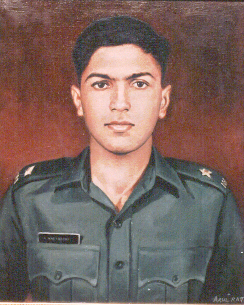
2nd Lieutenant Arun Khetarpal, son of Brigadier M.L. Khetarpal, was born on 14 October 1950, in Pune, Maharashtra . Arun came from a family with a long tradition of service in the Army. In Sanawar he distinguished himself both in academics and sports. In 1967 he joined the National Defense Academy (NDA) and then went on to Indian Military Academy . He was commissioned in the 17 Poona Horse on 13 June 1971. During the 1971 Indo-Pak War, the 47 Inf. Bde., with the 17 Poona Horse under command, was ordered to establish a bridge-head across the Basantar river in Shakargarh sector. The 47 Inf. Bde. Completed the task by 2100 hours on December 15th. It was now for the engineers to breach the enemy minefields and make a safe lane for the induction of the 17 Poona Horse in support of the bridgehead. While the engineers were half way through their task, the Indian troops at the bridgehead reported alarming activity of the enemy armour.
They requested immediate tank support. But the minefield had been cleared only partially by that time. At this critical juncture, the 17 Poona Horse decided to push through the minefield come what may. By first light on December 16th, the regiment established a link-up between the armour and the infantry at the bridgehead. At 0800 hours, the enemy made a counter-attack with an armour regiment, under the cover of a smoke screen. The target was the regimental pivot at Jarpal. As the Indians troops were heavily outnumbered, the Commander of 'B' Squadron requested reinforcement. At that time, 2nd Lt. Khetarpal was positioned close to the squadron with his troops in two tanks. He answered the call and moved out to face the enemy attack.
On the way, his troops came under fire from enemy strong points and recoilless gun nests, in the bridgehead zone. 2nd Lt. Khetarpal fiercely attacked these strong points; over-ran enemy defences and captured many enemy soldiers and recoilless guns at gunpoint. During one of these attacks, the commander of his second tank was killed on the spot leaving him alone. But he continued attack on the enemy strongholds single-handed, until all the enemy positions were overwhelmed. He then raced to the 'B' Squadron position. By the time he reached there, the enemy tanks were on the retreat. He pursued and destroyed one of these tanks. The 'B' Squadron Commander could persuade him to fall back in line after great difficulty. The enemy soon reformed for a second attack. This time they chose the sector held by 2nd Lt. Arun Khetarpal and two other Officers, for the main attack. The enemy employed a complete armoured squadron against these three tanks in order to achieve a breakthrough.
A fierce tank battle followed. As many as ten enemy tanks were destroyed and of these 2nd Lieutenant Khetarpal alone destroyed four. In the thick of the battle, two of the three Indian tanks became casualties - one was hit and another suffered mechanical failure. The third tank, which was 2nd Lt. Khetarpal's tank, also received a shot and burst into flames. The Commander of the tank troops ordered 2nd Lt. Khetarpal to abandon the burning tank. But realising the useful role of his tank in preventing a breakthrough he communicated the following message to his Commander, "No Sir, I will not abandon my tank. My gun is still working and I will get these bastards." Then he set about destroying the remaining enemy tanks. The last enemy tank, which he shot, was barely 100 metres from his position. At this stage his tank received a second hit. The brave Officer met his death denying the enemy the intended breakthrough. For his conspicuous gallantry in the face of the enemy, 2nd Lt. Arun Khetarpal was honoured with the highest wartime gallantry medal, the Param Vir Chakra, posthumously.
On 16 December 1971, the squadron Commander of ‘B’ Squadron, the Poona Horse asked for reinforcements as the Pakistani armour that was superior in strength, counter attacked at Jarpal, in the Shakargarh Sector. On hearing this transmission, 2nd Lt Khetarpal who was in ‘A’ Squadron, voluntarily moved along with his troop, to assist the other squadron. Enroute, while crossing the Basantar River, Second Lieutenant Arun Khetarpal and his troops came under fire from enemy strong points and RCL gun nests that were still holding out. Time was at a premium and as a critical situation was developing in the ‘B’ Squadron sector, Second Lieutenant Arun Khetarpal, threw caution to the winds and started attacking the impending enemy strong points by literally charging them, Overrunning the defence works with his tanks and capturing the enemy infantry and weapon crews at pistol point. In the course of one such daring attack one tank commander of his troop was killed. Second Lieutenant Arun Khetarpal continued to attack relentlessly until all enemy opposition was overcome and he broke through towards the ‘B’ Squadron position, just in time to see the enemy tanks pulling back after their initial probing attack on this squadron. He was so carried away by the wild enthusiasm of battle and the impetus of his own headlong dash that he started chasing the withdrawing tanks and even managed to shoot and destroy one. Soon thereafter, the enemy reformed with a squadron of armour for a second attack and this time they selected the sector held by Second Lieutenant Arun Khetarpal and two other tanks as the point for their main effort. A fierce tank fight ensued: ten enemy tanks were hit and destroyed of which Second Lieutenant Arun Khetarpal personally destroyed four, just then Second Lieutenant Arun Khetarpal was severely wounded. He was asked to abandon his tank but he realized that the enemy though badly decimated was continuing to advance in his sector of responsibility and if he abandoned his tank the enemy would break through, he gallantly fought on and destroyed another enemy tank. At this stage his tank received a second hit which resulted in the death of this gallant officer.
Second Lieutenant Arun Khetarpal was dead but he had, by his intrepid valour saved the day; the enemy was denied the breakthrough he was so desperately seeking. Not one enemy tank got through.
Second Lieutenant Arun Khetarpal had shown the best qualities of leadership, tenacity of purpose and the will to close in with the enemy. This was an act of courage and self-sacrifice far beyond the call of duty.
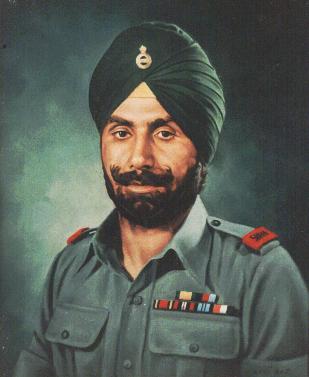
Lance Naik Karam Singh was born on 15 September 1915, in Barnala, Punjab . He was enrolled in 1 Sikh on 15 September 1941. He had earned a Military Medal in World War II. During the Jammu & Kashmir operations in the summer of 1948 the Indian Army made substantial gains in the Tithwal sector. This led to the capture of Tithwal of 23 May 1948. The enemy fled in utter confusion across the Kishanganga after dumping their arms and equipment in the river. But the enemy quickly recovered from this shock. They re-organised their forces and mounted a strong counter-attack to recover the lost ground. As a result, the Indian Army could not withstand the enemy pressure and withdrew from their positions across the Kishanganga River . Finally, they settled on the Tithwal ride to take on the enemy.
The battle of Tithwal went on for months. The enemy could not, however, make a dent on the Indian defences. On October 13th, they launched a desperate attack in brigade strength to evict the Indian Army from their strongly held positions. The objective was to recapture Richhmar Gali to the south of Tithwal and to outflank the Indian Army by marching on to Nastachur Pass to the east of Tithwal. Both attempts failed. During this attack, some bitter fighting took place in the Richhmar Gali area on the night of October 13th. The attack commenced with heavy shelling of guns and mortar. The fire was so devastating that nearly all bunkers in the platoon area were damaged. In this action the 1 Sikh played a very important role in beating back the enemy onslaught. Lance Naik Karam Singh was commanding a forward outpost when the enemy launched the attack. The enemy in vastly superior strength attacked his post. The outpost was attacked eight times and the Sikhs repulsed the enemy every time. When ammunition ran short, Lance Naik Karam Singh joined the main company position, knowing fully well that due to the heavy enemy shelling no help would be forthcoming. Although wounded, he brought back two injured comrades with the help of a third mate.
Ringed by enemy fire, it was almost impossible for them to break out. Ignoring all dangers, he crawled from place to place encouraging his men to keep up the fight. Often he beat back the enemy with grenades. Twice wounded, he refused evacuation and continued to hold on to the first-line trenches. The fifth enemy attack was very intense. Two enemy soldiers came so close to his position that he could not engage them without hitting his men. Lance Naik Karam Singh, jumped out of his trench and bayoneted the two intruders to death. This bold action so demoralised the enemy that they broke off the attack. Lance Naik Karam Singh and his men also repulsed three more enemy attacks, which followed. Lance Naik Karam Singh was an inspiration to his comrades and a threat to the enemy. He was honoured with the highest wartime gallantry medal, Param Vir Chakra, for his outstanding role in the battle of Tithwal.
CITATION
LANCE NAIR KARAM SINGH
1 SIKH (NO 22356)
Tithwal in Jammu and Kashmir was captured on 23 May 1948. After that date, the enemy made numerous attempts to recapture Richmar Gali, and thence Tithwal. On 13 October 1948, coinciding with Id, the enemy decided to launch a brigade attack to retake Richmar Gali, and bypassing Tithwal, advance into the Srinagar Valley . Lance Naik Karam Singh was commanding a section at Richmar Gali.
The enemy commenced its attack with heavy shelling of guns and mortars. The fire was so accurate that not a single bunker in the platoon locality was left unscathed.
Communication trenches caved in. Bravely, Lance Naik karam Singh went from bunker to bunker, giving succor to the wounded and urging the men to fight.
The enemy launched eight separate attacks that day. In one such attack, the enemy managed to obtain a foothold in the platoon locality. Immediately, Lance Naik Karam Singh, who was severely wounded by then, with a few men, hurled himself in a counter-attack and evicted the enemy after a close quarter encounter which accounted for many enemy dead, having been dispatched by the bayonet.
Lance Naik Karam Singh proved himself to be a dauntless leader of men in crisis. Nothing could subdue him and no amount of fire or hardship could break his spirit.
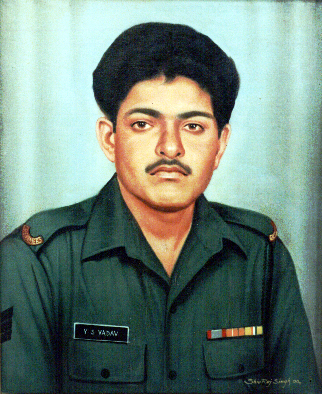
Grenadier Yogender Singh Yadav of 18 Grenadiers, was part of the Commando 'Ghatak' Platoon tasked to capture three strategic bunkers on Tiger Hill on the night of 3/4 July 1999. The approach was a vertical cliff face, snowbound at 16,500 feet. Grenadier Yogender Singh Yadav, volunteering to lead the assault, was climbing the cliff face and fixing the ropes for further assault on the feature. Halfway up, an enemy bunker opened up machine gun and rocket fire. His Platoon Commander and 2 others fell to the heavy volume of automatic fire. Realising the enormity of the situation, he continued to scale the cliff face alone through a volley of fire. In spite of having been hit by three bullets in his groin and shoulder, displaying superhuman strength and resolve, he climbed the remaining 60 feet, all by himself and reached the top. With rare grit and courage, he crawled up to the bunker critically injured and lobbed a grenade killing four Pakistani soldiers and neutralising enemy fire. This act was directly instrumental in facilitating the rest of the platoon in climbing up the cliff face.
Grievously injured, but with reckless disregard to personal safety, Grenadier Yogender Singh Yadav now charged on to the second bunker and neutralised it, with two of his colleagues in an extremely fierce hand-to-hand combat, killing three Pakistani soldiers. This extraordinarily gallant act motivated the rest of the platoon which quickly traversed the treacherous terrain and braving hostile fire, charged onto the enemy to capture Tiger Hill, a vital objective. Throughout this operation, from scaling the vertical cliff face by rope for destruction of 2 Pakistani bunkers in succession, Grenadier Yogender Singh Yadav displayed indomitable spirit, determination and action beyond the call of the duty. For his sustained display of the most conspicuous personal bravery and gallantry of the highest order in the face of the enemy, Grenadier Yogender Singh Yadav was awarded the Param Vir Chakra, India 's highest medal for gallantry.
CITATION
GRENADIER YOGINDER SINGH YADAV
18 GRENADIERS (2690-572)
Grenadier Yogender Singh Yadav was part of the leading team of a Ghatak Platoon tasked to capture Tiger Hill on the night of ¾ July 1999. The approach to the top was steep, snowbound and rocky. Grenadier Yogender Singh Yadav, unmindful of the danger involved, volunteered to lead and fix the rope for his team to climb up. On seeing the team, the enemy opened intense automatic, grenade, rocket and artillery fire killing the Commander and two of his colleagues and the platoon was stalled. Realising the gravity of the situation, Grenadier Yogender Singh Yadav crawled up to the enemy position to silence it and in the process sustained multiple bullet injuries. Unmindful of his injuries and in the hail of enemy bullets, Grenadier Yogender Singh Yadav continued climbing towards the enemy positions, lobbed grenades, continued firing from his weapons and killed four enemy soldiers in close combat an silenced the automatic fire. Despite multiple bullet injuries, he refused to be evacuated and continued the charge. Inspired by his gallant act, the platoon charged on the other positions with renewed punch and captured Tiger Hill Top.
Grenadier Yogender Singh Yadav displayed the most conspicuous courage, indomitable gallantry, grit and determination under extreme adverse circumstances.
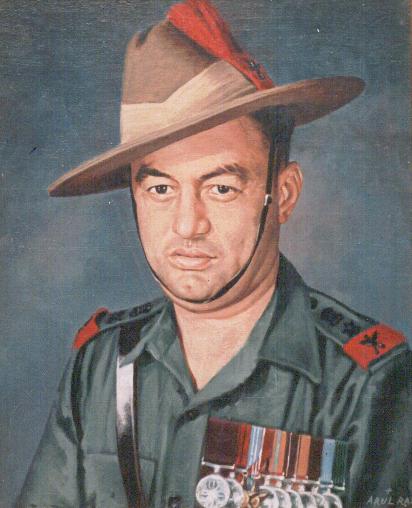
Major Dhan Singh Thapa, born on 10 April 1928 in Simla, Himachal Pradesh, was commissioned in the 8 Gorkha Rifles on 28 August 1949. The Sirijap valley, north of the Pangong Lake in Ladakh, was considered vital for the defence of Chushul airfield. The 1/8 Gorkha Rifles had outposts there to thwart any enemy encroachment in the area. One of these outposts named Sirijap-1 was held by a platoon of 'D' Company under the command of Major Dhan Singh Thapa when the Chinese attack came on 21 October 1962. At 0600 hours on 21 October 1962, the Chinese opened a barrage of artillery and mortar fire over Sirijap-1 post. The shelling continued till 0830 hours and the whole area was set ablaze. Some shells fell on the command post and damaged the wireless set. This put the post out of commission. The Chinese then attacked the outpost in overwhelming numbers. Major Thapa and his men repulsed the attack, inflicting heavy casualties on the enemy. But the Chinese were not dismayed by the defeat. They mounted another attack in greater number after shelling the area with artillery and mortar fire.
Major Thapa again rose to the occasion and repulsed the attack, inflicting heavy losses on the enemy. He encouraged his men to be prepared for a third assault, which came after a short while indeed. The third Chinese attack was, however, more powerful and intense. The enemy now came with tanks in support of the infantry. The platoon post was now in a much-depleted strength owing to the casualties suffered in earlier attacks. But the post held out till the ammunition lasted. When the Chinese finally overran it, he jumped out of his trench and killed many intruders in hand-to-hand fighting. He was eventually overpowered and killed. His cool courage, conspicuous fighting qualities and leadership were in the highest traditions of the Army. Major Thapa was believed to have been killed in this engagement, and the original citation given above reflects this. He was later discovered to have been taken prisoner by Chinese soldiers and after his release from the POW camp, he resumed his military career. For his gallant act, Major Dhan Singh Thapa was honoured with the highest wartime gallantry medal, Param Vir Chakra.
CITATION
MAJOR DHAN SINGH THAPA
1/8 GORKHA RIFLES (IC-7990)
Major Dhan Singh Thapa was in command of a forward post in Ladakh. On 20 October it was attacked by the Chinese in overwhelming strength after being subjected to intensive artillery and mortar bombardment. Under his gallant command, the greatly outnumbered post repulsed the attack, inflicting heavy casualties on the aggressors. The enemy attacked again in greater numbers after heavy shelling by artillery and mortar fire. Under the leadership of Major Thapa, his men repulsed this attack also with heavy losses to the enemy.
The Chinese attacked for the third time, now with tanks to support the infantry. The post had already suffered large numbers of casualties in the earlier two attacks. Though considerably reduced in number it held out to the last. When it was finally overrun by overwhelming numbers of the enemy, Major Thapa got out of his trench and killed several of the enemy in hand-to-hand fighting before he was finally overpowered by Chinese soldiers.
Major Thapa’s cool courage, conspicuous fighting qualities and leadership were in the highest traditions of our Army.

© 2026 Indian Army. This is the Official Indian Army Web Portal, maintained & managed by the Indian Army. Site hosted by NIC.
Content last updated on 21 Jan 2026